class 클래스명:
	def __init__(self):
    	self.전역변수명1 = 데이터

	def 함수명1:
    	self.전역변수명1 = 데이터

# java의 main
if __name__ == '__main__':
	클래스명이름 = 클래스명()
	print(클래스명이름.전역변수명1)
단일 상속시 사용법
class 클래스명:
	def __init__(self):
    	self.전역변수명1 = 데이터

	def 함수명1:
    	self.전역변수명1 = 데이터

# 상속
class 클래스2(클래스명):
	def __init__(self):
    	super().__init__()
    	self.전역변수명2 = 데이터

	def 함수명2:
    	self.전역변수명2 = 데이터


# java의 main
if __name__ == '__main__':
	클래스명이름 = 클래스2()
	print(클래스명이름.전역변수명1)
	print(클래스명이름.전역변수명2)
다중 상속 사용법
class 클래스1:
	def __init__(self):
    	self.전역변수명1 = 데이터

	def 함수명1:
    	self.전역변수명1 = 데이터

class 클래스2:
	def __init__(self):
    	self.전역변수명2 = 데이터

	def 함수명2:
    	self.전역변수명2 = 데이터


# 다중 상속
class 클래스3(클래스1, 클래스2):
	def __init__(self):
    	클래스1.__init__(self)
        클래스2.__init__(self)


# java의 main
if __name__ == '__main__':
	클래스이름 = 클래스3()
	print(클래스이름.전역변수명1)
	print(클래스이름.전역변수명2)
클래스 사용 예시
Java 코드 -> Python 코드1
package day03;

public class Animal {
	int life_span = 10;

	void fightTiger() {
		life_span = 0;
	}
}
package day03;

public class OopTest01 {
	public static void main(String[] args) {
		Animal ani = new Animal();
		System.out.println("life_span : " + ani.life_span);

		ani.fightTiger();
		System.out.println("life_span : " + ani.life_span);
	}
}
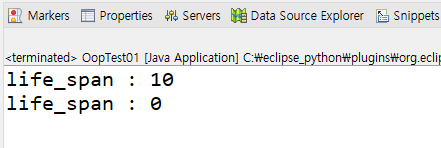
결과 화면1
class Animal:
    def __init__(self):
        self.life_span = 10

    def fightTiger(self):
        self.life_span = 0


if __name__ == '__main__':
    ani = Animal()
    print("life_span : ", ani.life_span)

    ani.fightTiger()
    print("life_span : ", ani.life_span)
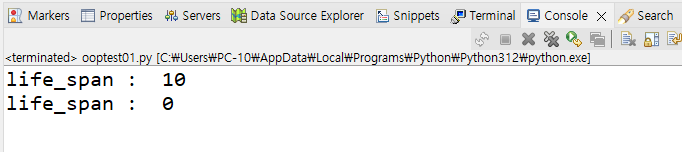
결과 화면3
Java 코드 -> Python 코드2
package day03;

public class Human extends Animal{
	int money = 0;

	void work() {
		money += 30000;
	}
}
package day03;

public class OopTest02 {
	public static void main(String[] args) {
		Human h = new Human();
		System.out.println("life_span : " + h.life_span);
		System.out.println("money : " + h.money);

		h.fightTiger();
		h.work();
		System.out.println("life_span : " + h.life_span);
		System.out.println("money : " + h.money);
	}
}
from day03.ooptest03 import Wonbin
from day03.ooptest04 import Mavely


class YoungHun(Wonbin, Mavely):
    def __init__(self):
        Wonbin.__init__(self)
        Mavely.__init__(self)
        # super().__init__() # 이런 경우 Wonbin만 반복받기에 둘 다 상속 받을 수 있게 해줘야 함


if __name__ == '__main__':
    yh = YoungHun()
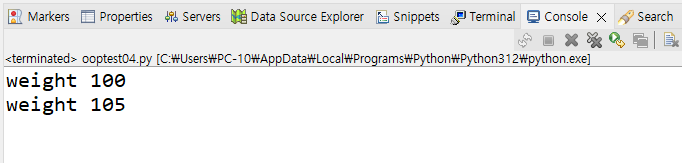
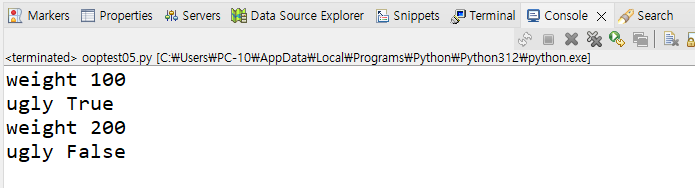
    print("weight",yh.weight)
    print("ugly",yh.flag_ugly)

    yh.eat(100)
    yh.plastic()

    print("weight",yh.weight)
    print("ugly",yh.flag_ugly)
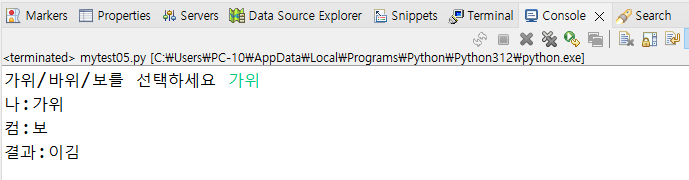
# 가위/바위/보를 선택하세요 가위
# 나:가위
# 컴:보
# 결과:이김
from random import random

me = input("가위/바위/보를 선택하세요 ")

com = random();
if com > 0.66:
    com = "가위"
elif com > 0.33:
    com = "바위"
else:
    com = "보"

#print(com)

if (me == "가위" and com == "보")|(me == "바위" and com == "가위")|(me == "보" and com == "바위"):
    result = "이김"
elif (me == "가위" and com == "바위")|(me == "바위" and com == "보")|(me == "보" and com == "가위"):
    result = "짐"
else:
    result = "비김"

print("나:{}".format(me))
print("컴:{}".format(com))
print("결과:{}".format(result))
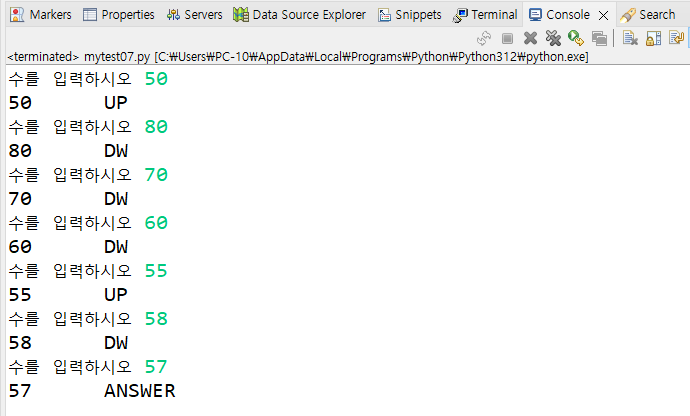
# com = (1 ~ 99까지를 넣어줌) 50
# 수를 입력하시오 40
# 40    UP
# 수를 입력하시오 60
# 60    DW
# 수를 입력하시오 50
# 50    ANSWER
from random import random


com = int(random()*99)
#print(com)

while True:
    su = int(input("수를 입력하시오 "))

    if su > com:
        print(str(su) + "\tDW")
    elif su < com:
        print(str(su) + "\tUP")
    else:
        print(str(su) + "\tANSWER")
        break
# 첫별수를 입력하세요 3
# 끝별수를 입력하세요 5
# ★★★
# ★★★★
# ★★★★★

su1 = int(input("첫별수를 입력하세요 "))
su2 = int(input("끝별수를 입력하세요 "))

def getStar(cnt):
    ret = ""
    for i in range(cnt):
        ret +="★"
    return ret

for i in range(su1, su2):
    print(getStar(i))